We believe that your menu is far more than a list of dishes and prices: it's one of the most powerful profit-driving tools in your restaurant. Every layout choice, every word of description, and every strategic placement has the potential to influence what your guests order and how much they spend.
The reality is that most restaurant owners treat their menus as an afterthought. They focus on the food itself (which matters, of course) but overlook the fact that strategic menu design can increase profits by 10-15% on an ongoing basis. A well-executed menu redesign can even boost revenue by up to 35%.
This guide walks you through the principles, psychology, and practical strategies that transform an ordinary menu into a profit-generating machine.
Understanding Menu Psychology
Before diving into tactics, it's worth understanding why menu design works in the first place. Your guests don't read menus the way they read books: from top to bottom, left to right. Eye-tracking studies have revealed that diners follow predictable patterns, and smart restaurateurs use this knowledge to their advantage.
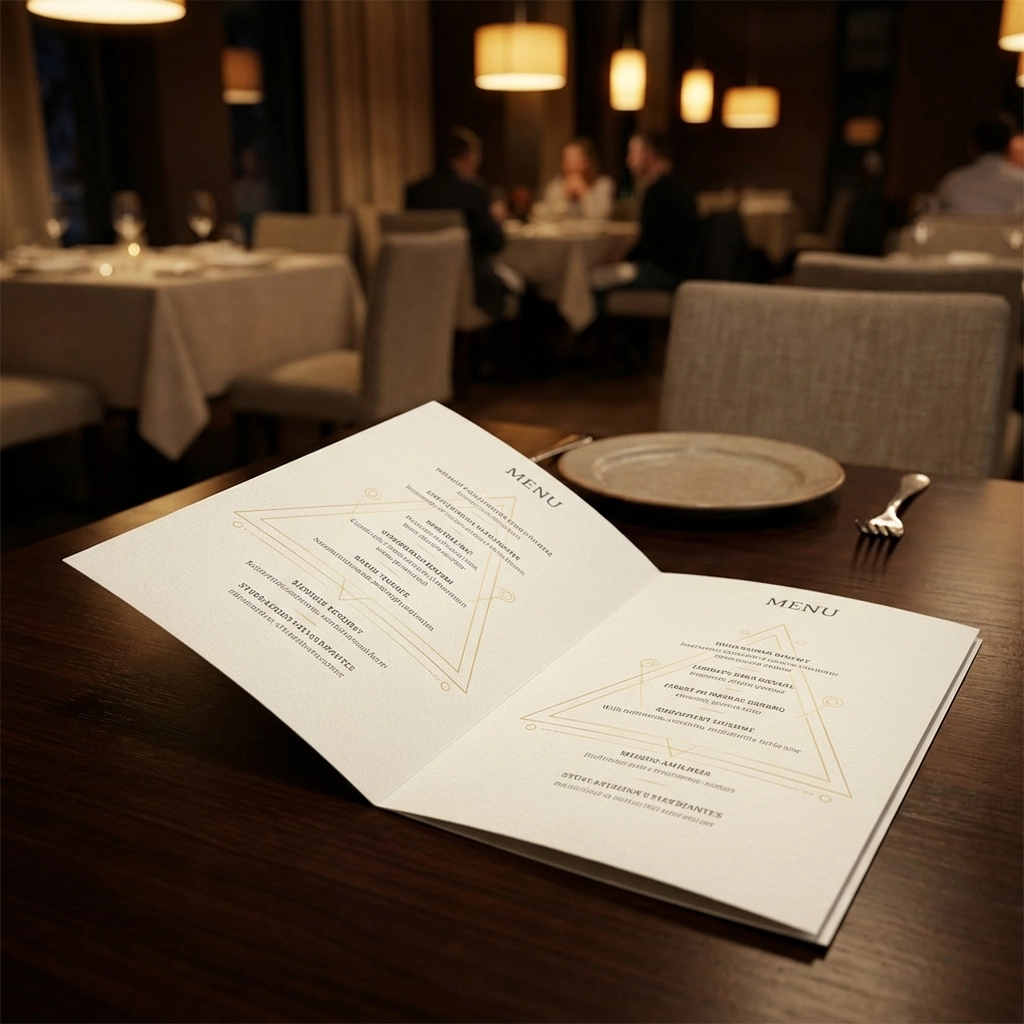
The "golden triangle" refers to the path most eyes naturally follow: from the center of the menu, to the upper right corner, then to the upper left. These prime real estate spots are where your highest-margin items should live.
Beyond placement, the way you describe dishes dramatically impacts perceived value. Words like "hand-crafted," "locally-sourced," and "house-made" create emotional connections that justify higher prices. Guests aren't just buying food: they're buying an experience, a story, and a sense of quality.
We believe that understanding these psychological principles isn't manipulation; it's simply smart communication that helps guests discover your best offerings.
The Four Categories of Menu Engineering
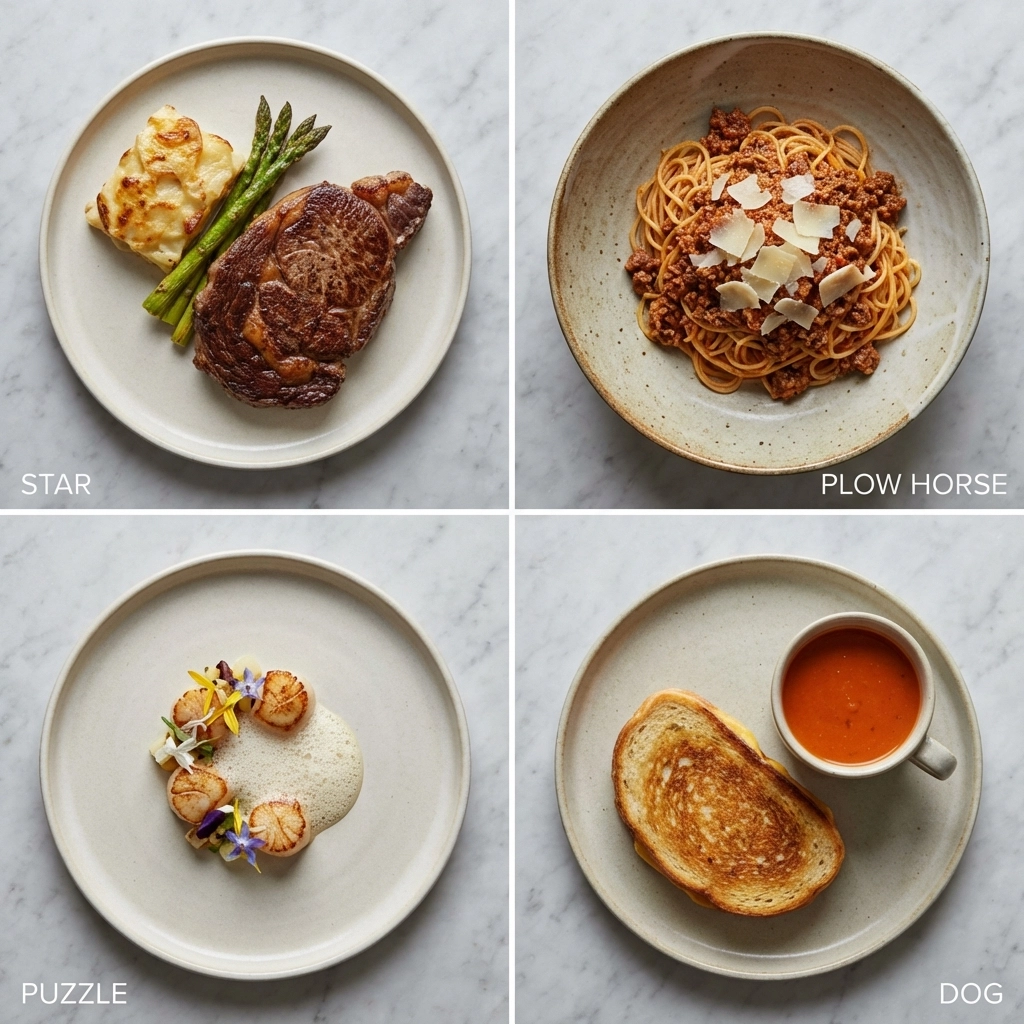
Every item on your menu falls into one of four categories based on two factors: profitability and popularity. Categorizing your dishes this way reveals exactly where to focus your attention.
Stars are your reputation-makers: high profit and high sales. These dishes deserve the spotlight. Place them prominently, train your staff to recommend them, and never let them fade into the background.
Plow Horses (sometimes called Opportunities) sell well but carry lower profit margins. These items keep guests coming back, but they need some work. Consider adjusting portion sizes, tweaking recipes to reduce food costs, or slightly increasing prices.
Puzzles offer high profit margins but don't sell as well as they should. Often, these dishes simply need better positioning, more appealing descriptions, or a visual refresh. They're hidden gems waiting to be discovered.
Dogs are the dishes you probably should remove: low profit and low sales. Every dog on your menu creates waste, complicates inventory, and distracts from your stronger offerings.
Recipe Analysis: Know Your Numbers
We believe that profitability starts with knowing exactly what each dish costs to produce. Without accurate recipe costing, you're essentially flying blind.
For every menu item, calculate:
- Ingredient costs per serving (including garnishes and accompaniments)
- Labor costs for preparation and plating
- Overhead allocation for utilities, equipment wear, and other indirect costs
Your POS system and accounting software can help automate much of this process. The goal is to identify your contribution margin for each dish: the amount left over after direct costs that contributes to covering your fixed expenses and generating profit.
Once you have these numbers, patterns emerge. You might discover that your best-selling entrée actually loses money when labor is factored in, or that a simple appetizer you've been overlooking delivers exceptional margins.
This data-driven approach removes guesswork and emotion from menu decisions. It's not about what you think should sell: it's about what the numbers actually tell you.
Visual Design Principles That Drive Sales
The physical layout of your menu guides attention and influences decisions. Here are proven design strategies that work:
Strategic placement matters. Position your Stars in the golden triangle: center, upper right, and upper left. These are the spots where eyes naturally land first.
Use visual anchors wisely. Boxes, bold fonts, illustrations, and whitespace draw attention to specific items. Use these techniques sparingly to highlight your most profitable dishes without overwhelming the layout.
Downplay pricing. Remove dollar signs entirely, avoid bold fonts on prices, and consider using psychological pricing like $14.95 instead of $15. When prices blend into the design rather than standing out, guests focus more on the food and less on the cost.
Organize into clear categories. Appetizers, entrées, sides, and desserts should each have distinct sections. Within each category, place your Stars prominently and position Puzzles near them to increase their visibility.

Write descriptions that sell. Instead of "Grilled Salmon," try "Wild-Caught Pacific Salmon, herb-crusted and grilled to perfection, served over seasonal vegetables." Descriptive language increases perceived value and justifies premium pricing.
Food and Drink Pairings: A Hidden Profit Center
We believe that beverage programs represent one of the most underutilized profit opportunities in the restaurant industry. Strategic food and drink pairings not only enhance the dining experience but significantly increase check averages.
Consider these approaches:
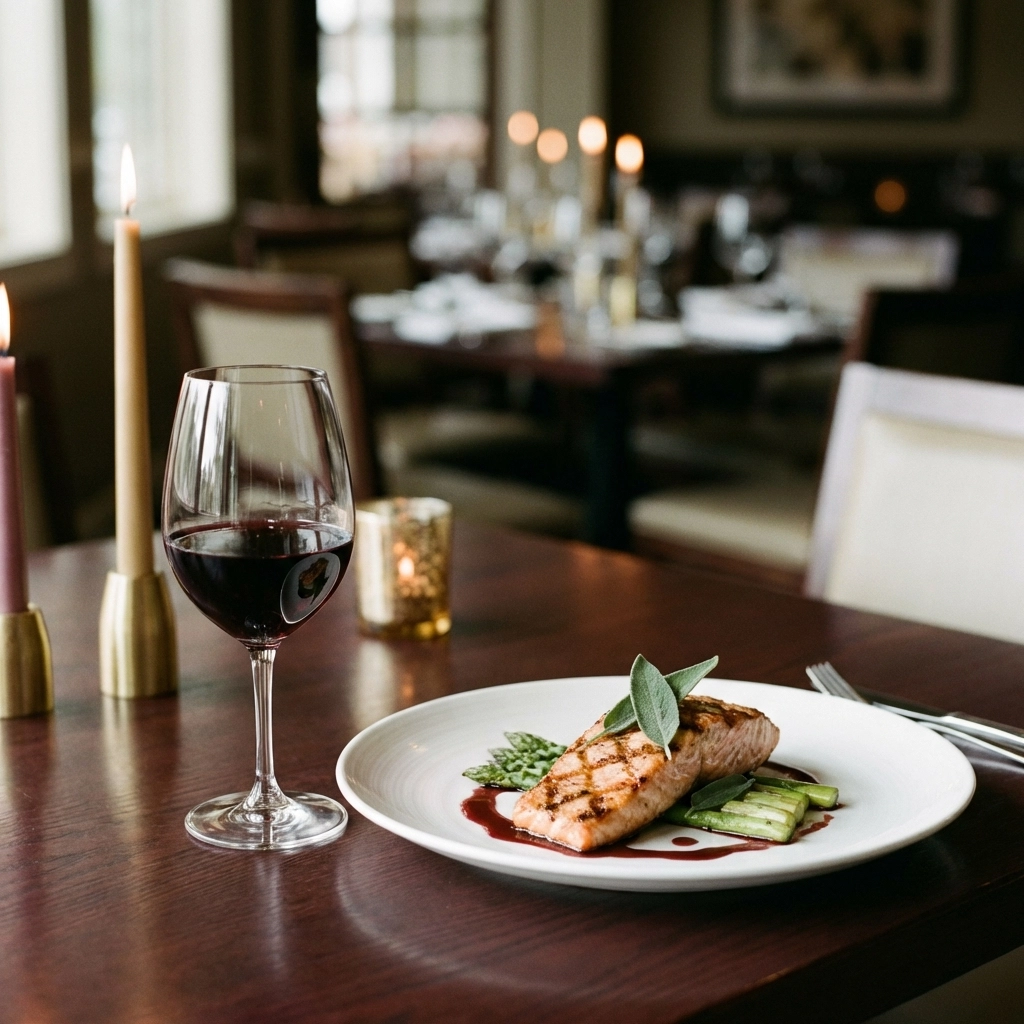
Menu callouts. Add pairing suggestions directly on your food menu. A simple line like "Pairs beautifully with our house Cabernet" prompts guests to order both items.
Staff training. Equip your servers with knowledge about which wines, beers, or cocktails complement specific dishes. When a server confidently suggests a pairing, guests perceive it as expertise rather than upselling.
Tasting menus with pairings. Offer prix fixe options that include beverage pairings at each course. These packages often deliver higher margins than à la carte ordering while creating memorable experiences.
Signature cocktails. Develop house cocktails designed to complement your most popular dishes. Give them creative names that tie into your brand identity.
Beverage margins typically exceed food margins significantly, making this strategy doubly effective: you increase both ticket size and overall profitability.
Happy Hour Programs That Build Business
Happy hour isn't just about discounted drinks: it's a strategic tool for building traffic during slower periods and introducing new guests to your establishment. The key is designing a program that drives volume without eroding margins.
Create a separate happy hour menu. Feature smaller portions, shareable plates, and drink specials that deliver value while maintaining acceptable margins. This approach attracts price-conscious guests without training them to expect discounts on your full menu.
Highlight high-margin items. Your happy hour menu should feature dishes with strong contribution margins. Appetizers, bar snacks, and sides often work perfectly here.
Use happy hour as an introduction. Many guests who discover your restaurant during happy hour return for full-service dining. Consider including a small card with your happy hour check that offers a discount or incentive for a return visit during regular hours.
Time-limit strategically. Ending happy hour before your dinner rush ensures tables turn over to full-price guests and creates urgency that drives decisions.
Implementation and Ongoing Refinement
Menu engineering isn't a one-time project: it's an ongoing discipline. We recommend the following implementation approach:
Week one: Complete recipe costing for every item and categorize dishes into Stars, Plow Horses, Puzzles, and Dogs.
Week two: Redesign your menu layout based on the principles outlined above, repositioning items and rewriting descriptions.
Week three: Train your entire front-of-house team on the changes, emphasizing which items to recommend and why.
Ongoing: Review menu performance quarterly. Track sales data, monitor food costs, and make seasonal adjustments based on changing ingredient prices and guest preferences.
The restaurants that see the greatest results are those that treat menu engineering as a continuous improvement process rather than a one-time fix.
Taking the Next Step
Your menu has the potential to transform your restaurant's profitability without raising prices, cutting portions, or compromising quality. It simply requires strategic thinking, accurate data, and thoughtful design.
We believe that every establishment has the potential to increase profits through smarter menu engineering. At Soderblom Consulting, we specialize in helping restaurant owners analyze their operations and implement changes that not only attract guests but retain them as loyal customers.
Ready to unlock the profit potential hiding in your menu? Contact us to discuss how strategic menu design can transform your bottom line.